
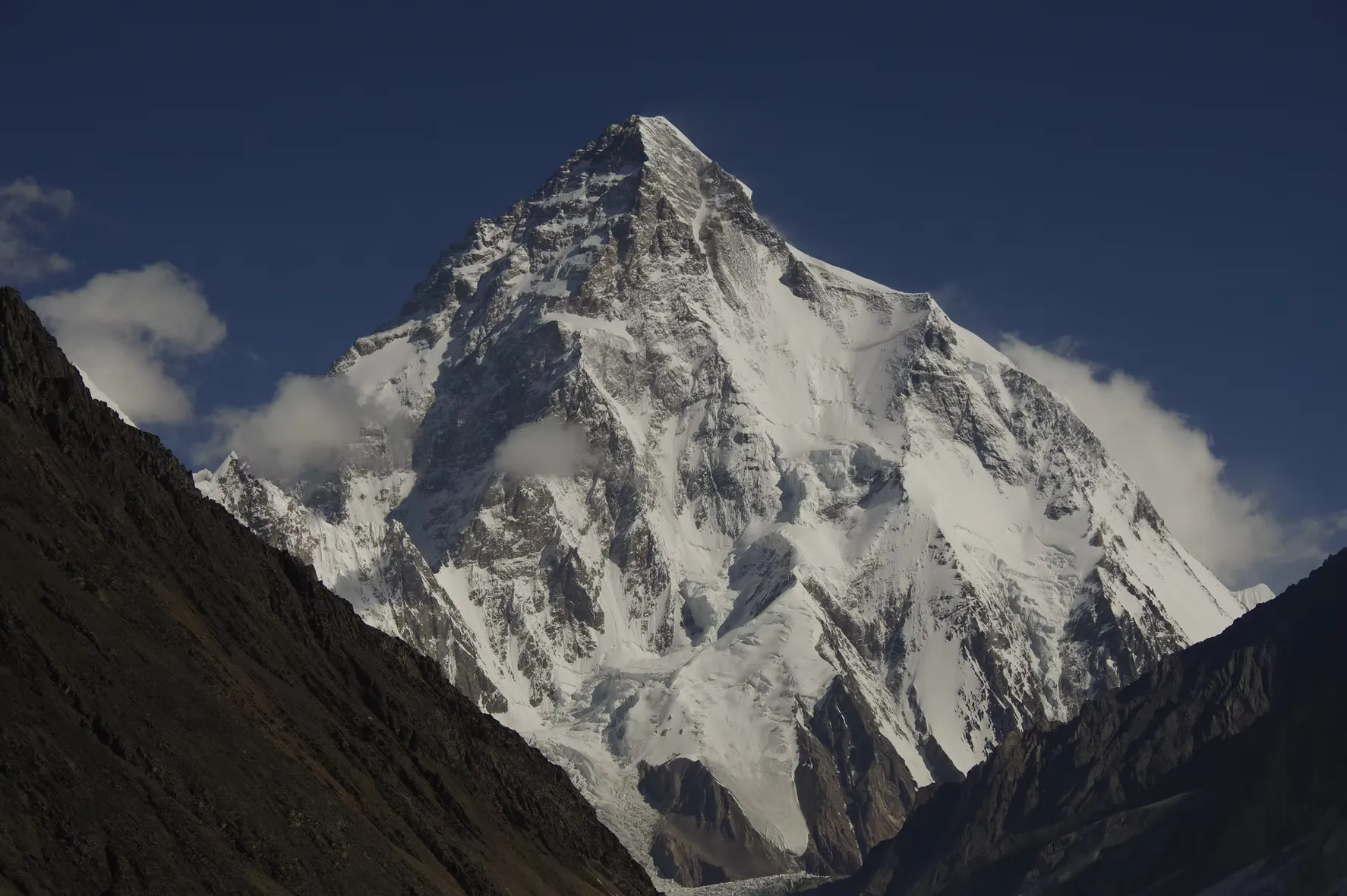
It’s the ultimate debate in the mountaineering world, whispered in the tea houses of Namche Bazaar and argued over in the base camps of the Karakoram. On one side, you have Mount Everest (8,848m), the roof of the world, the mountain that defines high-altitude ambition. On the other, you have K2 (8,611m), the “Savage Mountain,” a technical brute that respects nothing but elite skill and perfect timing.
If you’re looking at the numbers, Everest is taller. But if you’re looking at the mountain, K2 is a different beast entirely. However, let’s be clear: neither mountain is “easy.” To stand on the summit of either is to stand at the limit of human survival.
At Moving Mountains, we don’t just guide these peaks; we live them. If you’re a trekker looking at the K2 Base Camp Trek or an aspiring climber eyeing your first 8,000m peak, understanding the nuances of these two giants is essential.
1. Physicality vs. Technicality
The most fundamental difference lies in how the mountain tests you.
Everest (The Ultimate Altitude Test): Make no mistake — climbing Everest is an immense physical undertaking. At 8,848 meters, you are in the “Death Zone,” where the body is literally dying every minute it remains. The physical toll of moving your body through deep snow at that altitude, even with supplemental oxygen, is something that few people on earth can truly comprehend. It requires a massive aerobic engine and the ability to endure weeks of physical degradation. While the standard Southeast Ridge route is less technically complex than K2, the sheer height of Everest makes it a monumental test of human endurance.
K2 (The Technical Beast): K2 offers a different kind of challenge: technical intensity. From the moment you leave Advanced Base Camp, you are climbing. You face sustained technical sections like House’s Chimney (a 30-meter crack in a rock wall) and the Black Pyramid (a mix of rock and ice climbing). Even the summit push involves the infamous Bottleneck, a 50-60 degree couloir sitting directly under a massive, unstable serac. On K2, the difficulty isn’t just the altitude; it’s the fact that you have to perform high-stakes, technical moves while starving for oxygen. Increasing the weather in the Karakoram is adding to this equation as well.
2. The Fatality Rate
The statistics tell a sobering story of risk.
•Everest: As of 2026, the normalized death rate on Everest has hovered around 1.1% for those using supplemental oxygen. The presence of massive infrastructure, fixed ropes from base camp to summit, and extensive Sherpa support has made the mountain “safer” than it once was, but it remains a place where one mistake or a sudden storm can be fatal.
•K2: K2’s historic fatality rate is roughly 23-25%. While modern logistics have brought this down, it remains significantly higher than Everest. For every four people who reach the summit of K2, one person has historically died. It is a mountain that offers almost zero margin for error.
3. Weather and Isolation: The Karakoram Factor
Everest sits in the Himalayas, where the monsoon-driven weather windows are relatively predictable. K2 sits in the Karakoram of Pakistan, a range known for its violent, unpredictable storms.
•The Window: On Everest, weather windows can last for a week or more, allowing large groups to summit. On K2, you might get a 24-hour window that opens and shuts with lethal speed.
•The Rescue: If you get into trouble on Everest, there are hundreds of people and helicopter rescue options (up to a certain altitude). On K2, you are in the heart of the Gilgit-Baltistan wilderness. Rescue is difficult, often impossible, and usually dependent entirely on your own team. This is why we emphasize rigorous training for all our expeditions.
4. The “Commercial” Gap
Everest has become the focal point of commercial mountaineering. This means better trails, better camps, and more support — but it also means “conga lines” at the Hillary Step. This creates a unique danger: exhaustion and oxygen depletion while waiting for others to move.
K2 remains a “climber’s mountain.” The technicality of the route acts as a natural filter. To stand on the summit of K2, you need more than just a large checkbook and strong cardio; you need technical skills and a level of self-sufficiency that takes years to build.
The Verdict: Which is Harder?
If “harder” means which mountain requires more pure technical skill and carries a higher objective risk, the answer is K2. Because of the remoteness within Gilgit-Baltistan, there is an added risk in climbing with little safety net.
For most, the journey to these giants starts with seeing them. Whether it’s the K2 Base Camp Trek to stand in the shadow of the Savage Mountain, or a “training peak” like Spantik (7,027m) to test your body at 7,000 meters, the Karakoram is the ultimate proving ground.
Are you ready to see the Karakoram for yourself? Explore our K2 Base Camp & Gondogoro La Trek and witness the world’s most difficult mountains with your own eyes.