
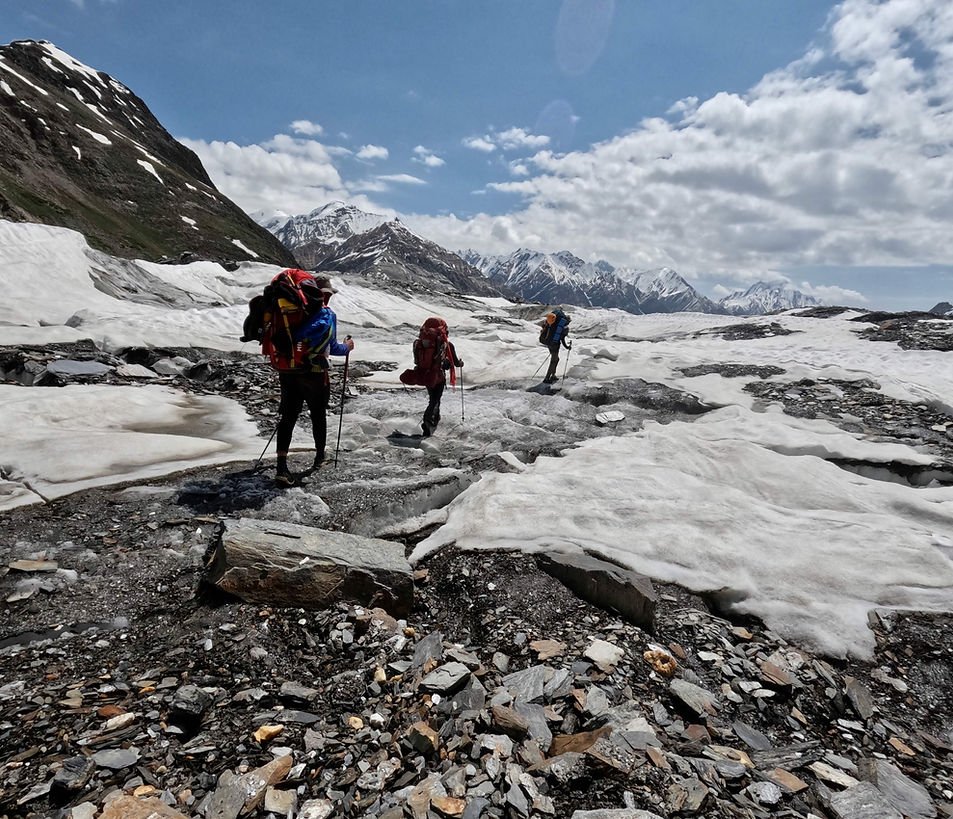
Standing at 7,027 meters on the summit of Spantik (Golden Peak) is a transformative experience. It is the moment a trekker truly becomes a mountaineer. But the leap from the Baltoro glacier to the Southeast Ridge of Spantik is not just a matter of elevation—it is a matter of physical and mental evolution. While Spantik is often called the “easiest” 7,000m peak in the Karakoram, “easy” is a relative term at an altitude where the air holds less than 40% of the oxygen found at sea level.
To succeed on Spantik, you don’t need to be an elite athlete, but you do need to be a robust one. You need the aerobic capacity to move for 8+ hours a day, the functional strength to carry a 15kg pack up 40-degree snow slopes, and the mental grit to endure the “expedition shuffle” in the thin air of Camp 3.
At Moving Mountains, we believe preparation is the ultimate form of respect for the mountain. This 24-week periodization plan is designed specifically for the Southeast Ridge of Spantik, moving you from a solid fitness base to peak expedition readiness.
The Spantik Physical Profile: What Are You Training For?
Before you lace up your boots, you must understand the specific demands of the Spantik Expedition:
•Aerobic Efficiency: The majority of the climb is a “slow-burn” aerobic effort. You need a massive “Base” to ensure your heart rate stays low while moving, preserving precious energy for the summit push.
•Muscular Endurance: The Southeast Ridge is long—over 8km from Base Camp to the summit. Your legs and core must be conditioned to handle thousands of repetitive steps under load.
•Technical Functional Strength: While not overly technical, you will be using fixed ropes and jumars on steeper sections. Upper body and grip strength are more important here than on a standard trek.
The 24-Week Periodization Plan
This plan is divided into four distinct phases. It assumes you already have a baseline of fitness (can hike for 4-5 hours comfortably).
Phase 1: Base Building (Weeks 1–8)
Goal: Build a massive aerobic engine and strengthen connective tissue.
In this phase, 80% of your training should be in Zone 2 (conversational pace). This builds the mitochondrial density required for high-altitude endurance.
•Aerobic: 3–4 days/week of steady-state hiking, running, or cycling. Start at 45 minutes and progress to 90 minutes.
•Strength: 2 days/week focusing on “The Big Three” for mountaineers: Weighted Step-ups, Lunges, and Core (planks, Russian twists).
•Flexibility: 1 day/week of active recovery/yoga.
Phase 2: Strength & Load Carriage (Weeks 9–16)
Goal: Transition aerobic base into mountain-specific strength.
Now we introduce the “Mountaineer’s Secret Weapon”: The Weighted Pack.
•Aerobic: Maintain Zone 2 volume, but transition one session to a “Hill Bound” workout.
•Load Carriage: Once a week, go for a 3–5 hour hike with a pack. Start with 5kg and add 1–2kg each week until you reach 15kg. This conditions your shoulders, hips, and lower back for the trek to Camp 1 and Camp 2.
•Strength: Increase weight in the gym. Focus on eccentric lowering (the “down” part of a step-up) to protect your knees for the descent.
Phase 3: Specificity & Peak (Weeks 17–22)
Goal: Simulate the demands of Spantik’s Southeast Ridge.
This is the hardest phase. We are looking for “fatigue resistance.”
•Back-to-Back Days: Twice a month, do long weighted hikes on both Saturday and Sunday. This simulates the multi-day effort of moving between high camps.
•Technical Prep: If possible, incorporate some glacier travel or crampon practice on local terrain.
•The “Summit Simulation”: Week 21 should be your highest volume week. Aim for a “Big Day” of 8–10 hours of movement with a full pack.
Phase 4: The Taper (Weeks 23–24)
Goal: Arrive in Islamabad fresh, healed, and hungry for the mountain.
The biggest mistake climbers make is training right up until the flight. You cannot “cram” fitness in the last two weeks.
•Reduce Volume: Cut your training hours by 50% in Week 23 and 70% in Week 24.
•Maintain Intensity: Do short, sharp sessions to keep the engine primed, but avoid anything that causes deep fatigue.
•Focus on Sleep & Nutrition: Your body does its final adaptations during rest.
Mental Preparation: The 7,000m Mindset
Training for Spantik isn’t just about the legs; it’s about the head. At 6,000 meters, your brain will tell you to stop. It will find a thousand reasons why “Camp 2 is high enough.”
To counter this, your training must include “Discomfort Practice.” Go for that hike when it’s raining. Do that final set of step-ups when you’re tired. Building the habit of “choosing the hard path” during training is what will carry you through the long, cold hours of summit night on the Golden Peak.
Start Your Journey to 7,000m
Spantik is the perfect bridge for those who have experienced the K2 Base Camp Trek and want to see what lies above the trekking trails. It is a mountain that demands much, but gives back even more in perspective and pride.
Are you ready to commit to the plan? Our 2026 Spantik Expedition is now open for applications. We provide the local expertise, the logistical backbone, and the expert guiding—you just need to bring the fitness.