
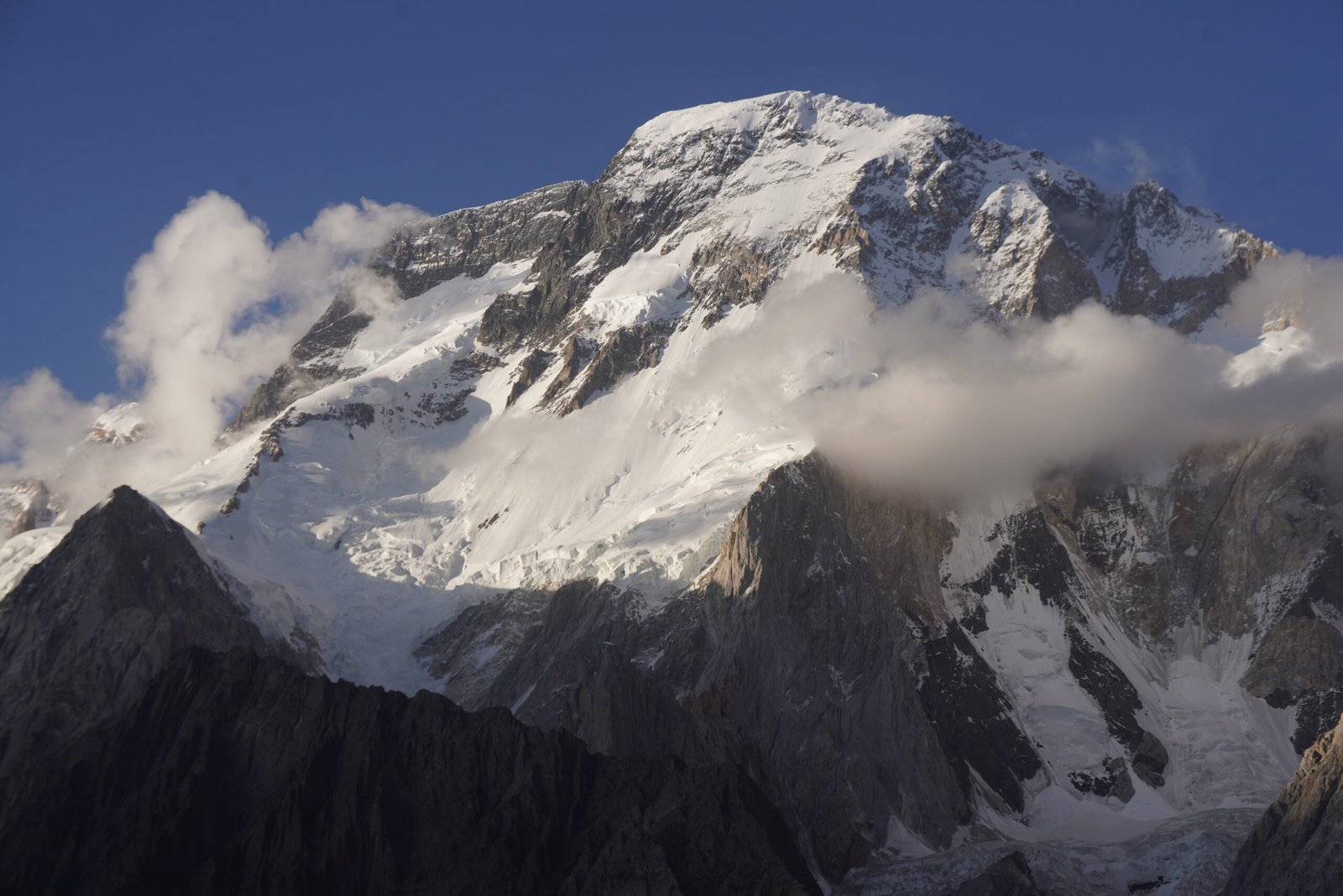
For any ambitious high-altitude climber, the transition from 7,000-meter peaks like Spantik to the legendary “Death Zone” of the 8,000ers is the ultimate rite of passage. In the Karakoram of Pakistan, two giants stand as the most logical and rewarding entry points: Broad Peak (8,051m) and Gasherbrum II (8,035m).
At Moving Mountains, we’ve spent our lives in the shadow of these giants. We’ve guided trekkers to Concordia and led climbers to the summits of both peaks. The question we get asked most often by aspiring 8,000m climbers is: “Which one should I choose first?”
While both are technically “accessible” by 8,000m standards, they offer fundamentally different challenges. This is our expert, no-nonsense comparison to help you decide which peak is right for your first 8,000-meter expedition.
Gasherbrum II: The “Easiest” 8,000er?
Gasherbrum II (GII) is frequently cited as one of the most approachable 8,000-meter peaks in the world, often compared to Cho Oyu in Nepal. But don’t let the “easy” label fool you—this is still a serious Karakoram expedition.
The Technical Challenge
The normal route on GII follows the Southwest Ridge. The primary obstacle is the Gasherbrum Icefall, a chaotic labyrinth of crevasses and ice towers that requires careful navigation and early morning starts to minimize objective danger. Beyond the icefall, the climbing is mostly on moderate snow slopes, with some steeper sections (up to 40-45 degrees) leading to the “Banana Ridge.”
The final summit push involves a long, exposed traverse that requires steady footwork and mental focus. While not “technical” in the rock-climbing sense, the sheer scale and altitude make it a grueling test of endurance.
Logistics and Success Rates
GII generally boasts a higher success rate than Broad Peak, with commercial expeditions often seeing 50-60% summit success . The base camp is situated on the upper Baltoro Glacier, providing a stunning but demanding environment. Because it is often considered safer and more straightforward, it attracts a steady stream of commercial expeditions, meaning fixed ropes are usually well-maintained.
Broad Peak: The “Savage” Alternative
Broad Peak stands directly across the Godwin-Austen Glacier from K2. While it lacks the brutal reputation of its neighbor, it is a mountain that demands respect for its sheer physical toll and technical nuances.
The Technical Challenge
The normal route on Broad Peak is often considered less technically complex than GII’s icefall, but it is physically more demanding. The climb involves steep snow and ice slopes from the start, with several technical sections on rock and mixed terrain between Camp 2 and Camp 3.
The true challenge of Broad Peak, however, is the Summit Ridge. After reaching the “Col” at 7,900m, climbers must navigate a long, narrow, and highly exposed ridge to reach the true summit (8,051m). Many climbers mistake the “False Summit” for the true highest point, and the extra hour of technical ridge-traversing at 8,000+ meters is where many expeditions fail.
Logistics and Success Rates
Broad Peak’s base camp is one of the most iconic in the world, offering a front-row seat to K2. However, the mountain is notorious for its long summit days—often 15 to 20 hours round-trip from Camp 3. Success rates on Broad Peak are typically lower than GII (often between 25% and 40%), largely due to the difficulty of the final ridge and the mountain’s fickle weather .
Head-to-Head Comparison
| Feature | Gasherbrum II (8,035m) | Broad Peak (8,051m) |
| Technical Difficulty | Moderate (Icefall navigation) | Moderate-High (Technical ridge) |
| Objective Danger | Higher (Icefall/Avalanche) | Lower (Mostly rock/ice fall) |
| Summit Day | 12–14 hours | 15–20 hours |
| Success Rate | Higher (~50-60%) | Lower (~30-40%) |
| Best For | Those seeking a safer, more “standard” first 8,000m experience. | Those wanting a more “pure” mountaineering challenge with iconic views. |
Which One Is Right for You?
Choosing between these two comes down to your personal climbing style and goals:
•Choose Gasherbrum II if: You want the highest statistical chance of reaching an 8,000m summit. You are comfortable with glacial travel and icefall navigation, and you prefer a route that is more consistently snow-based.
•Choose Broad Peak if: You want to stand in the “Throne Room” directly opposite K2. You have strong endurance for extremely long summit days and are comfortable with exposed ridge-traversing on mixed terrain.
Preparing for the Leap
Regardless of which peak you choose, the preparation remains the same. You need a solid foundation in Karakoram climbing skills, excellent cardiovascular fitness, and a deep understanding of altitude and safety.
At Moving Mountains, we don’t just lead expeditions; we build climbers. Our local Hunza-based team provides the logistical support and expert guidance you need to tackle your first 8,000m peak with confidence.
Ready to take the next step? Explore our 8,000m expeditions and start your journey to the summit.
References
[1] Arnette, A. (n.d.). The 8000ers. Alan Arnette. Retrieved from