
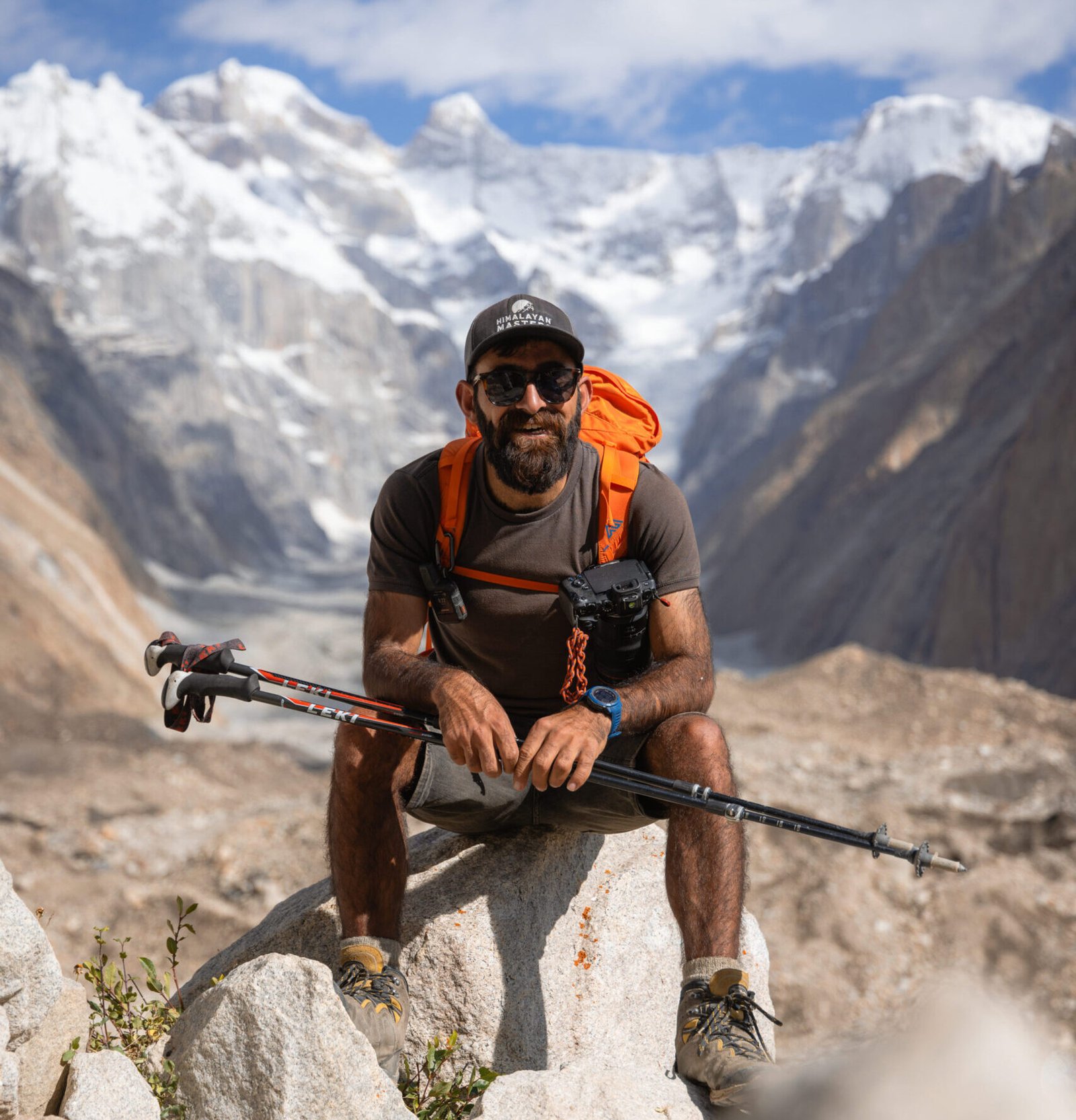
In the days since Sohail’s passing, so much has been written about him from so many sources, but little has been written about him by those he knew and loved. Much of what Sohail and I spoke about was telling his own story, on his own terms, so here is our tribute to the man who moved so much more than just mountains.
Sohail was born in 1992 in Hunza Valley, surrounded by the peaks of the Karakoram. His father was a mountain guide, and his mother worked as a bookkeeper. Sohail had a younger brother, Tufail, who was born one year later. He was deeply devoted to his studies in his early life and moved away from home at a young age to pursue opportunities that were not available in Hunza at the time. He completed his studies at an elite secondary school, where he also became passionate about photography. He moved to Islamabad to study mathematics at university and left just short of finishing his bachelor’s degree due to his father’s passing and an unending desire to spend his time in the mountains. His passion for numbers continued with him for many years, as he saw the mountains in the same way — as an abstract picture that he would put reasoning behind.
Shortly after leaving university, Sohail began to follow in his late father’s footsteps and lead trips in the mountains of Pakistan. He worked his way up, often washing dishes, working with porters, and doing whatever needed to be done to make ends meet. After a few years spent working with Pakistani companies, Sohail began to work with companies from both Europe and the US. He would guide trips to the Karakoram, Himalaya, and Hindu Kush and show those from outside the beauty of his home. That beauty wasn’t limited to just the physical; he deeply believed in connecting people across cultures to bridge those gaps.
As the years passed, Sohail started to think not just about trekking, but about climbing the high peaks he grew up near. In 2021, that opportunity presented itself when Sirbaz Khan took him on an expedition to Gasherbrum II to be part of his team that year. Sohail worked tirelessly on the expedition and acted as a kitchen boy, porter, climber, guide, photographer, and everything else. He successfully summited the mountain without oxygen, and a newfound love of reaching the highest peaks was born. In between climbs, he continued to guide treks as a means to provide for his family, and in 2022, he returned to the high peaks of the Karakoram and, again with Sirbaz, successfully climbed K2, followed by Gasherbrum I, without oxygen. Days after finishing that climb, he started off again from Skardu, guiding a group to Snow Lake and Hispar La — it was always Sohail’s dream to cross Hispar La and walk home to Hunza via the mountains he had just climbed.
Climbing those mountains proved to be the pivotal point in both his guiding and climbing careers. Soon after, he had an opportunity to travel outside of Pakistan for the first time to attempt Manaslu in Nepal without O2. An avalanche that year prevented summits, but it reinforced his love of not just climbing, but of introducing the talents of Pakistani climbers to the world. Every expedition he went on, he would return with a roster of friends and stories from those who crossed his path. He soon after began his first introductory IFMGA course in Kathmandu and fell more in love with Nepal and the theory of climbing. Until that point, Sohail would study geography, topography, and the mathematics behind the mountains and the winds on his own — but with this course, the independent studies he had undertaken were taught in a practical way. He would spend his off days climbing at the bouldering wall in Kathmandu and making friends from all over. He was given the opportunity to guide a group to Island Peak that year and, without hesitation, jumped on board. He was an invaluable member of the team, now guiding for the first time in a country outside of Pakistan.
Much has been said about Sohail staying with the slowest climber and pushing them to their limits, and I can testify that this is true. I was the slowest climber on Island Peak, and he pushed me until I made it to the top. When altitude sickness hit me part of the way down, he tied me to his harness and held my hand all the way down. When a Sherpa complained that we were going too slowly, Sohail told them it was fine — the Sherpa could leave us, and we would make it down in time. This is just who Sohail was. He never asked for anything more; he just did what was right.
In 2024, Sohail started to execute on his long-time dream of opening a travelers’ hostel in Hunza Valley. In the spring of that year, Hostel Nomads was opened with his close friends alongside him. He created a space that was filled with travelers from all over the world — it was not uncommon to have people from Europe, the US, Australia, and South America milling about, talking about their plans. In peak season, not only was the hostel full, but the garden was full of pitched tents from those who had come to visit. People from Hunza would come by to use it as a place to gather, and climbing equipment was kept for both locals and tourists to use. Jobs were created for guides, and fair wages were paid for their work. The dream that was started in 2024 continues to this day, with yearly additions to the space. In 2025, a bouldering wall was built where anyone — from local guides and climbers to tourists to young boys and girls from the area — can come and practice.
2024 was also the last year Sohail would work for another operator. At the end of the guiding season, he decided that it was time to start his own company with friends from both Hunza and abroad to create a new kind of Pakistani company — one where locals would be paid fairly, where career opportunities would be created, and where clients would get a premium experience for a price far less than that of Western operators. He firmly believed in empowering those around him and providing opportunities for the youth and for women as well. This was the same year he was finally able to get his own professional camera and take his photography to the next level. He could always be spotted with his signature hat, sunglasses, and camera strapped to his pack.
The following year, with little support, Sohail organized a climb for some of the younger alpinists from Hunza to Nanga Parbat. He summited and shortly after departed for K2, this time to climb on his terms and to summit without a porter and without O2. Sohail was the only climber to do two mountains that summer without assistance. He bravely went up the mountain after his own climb to assist in bringing others down who had been injured or killed. Sohail knew that doing so risked his own safety, but he knew he could not live with himself if they were left up there on their own.
Tragically, 2026 was the year it all came together — the year the first fixed departures under Moving Mountains launched, with treks to K2 Base Camp, Snow Lake, local Hunza treks, and an expedition to Broad Peak. In the days leading up to his departure for Broad Peak, the foundation was set for the following years and for what was to come. He was so proud that all groups had successfully crossed their passes that year and that clients were equally happy. The work Sohail had long dreamed of was finally all coming together.
So much has been said about the 10 climbers that we lost on July 30, 2026, but Sohail would not want to be remembered just for that day — he would want to be remembered as a man who loved deeply and cared for his family and friends more than anything else. Ask anyone who knew him, and they would all tell you his mother was his entire world. He was a man who found his greatest peace in the mountains and yearned to connect with those across the world, proving that you can find commonality with anyone. A man who never sought credit for doing what was right, but one who quietly stayed in the background until the very end. A man who fought for equal pay for Pakistani guides and for improved conditions for porters, who gave his tips to porters so they had a little something extra at the end. He would laugh at all those writing about him now who refused to give him a platform before, knowing that the loudest one is not the most important.
Sohail was deeply committed to everything he did, and he was so happy to be leading Mallory Geis on her first 8,000-meter peak. The two had met three years prior, when she came to Pakistan for the first time, and he guided her on a few hikes, only for her to begin her own love affair with the mountains. Soon, he guided her across the Three Passes Trek in Nepal and successfully summited Lobuche East. The next year, they attempted Mera Peak and successfully summited as well. Sohail spoke so highly of Mallory and all of her potential in the mountains and beyond. Let their ends not define them, but the journey that took them both to places that brought them peace.
Sohail’s legacy will not be forgotten. His work on the hostel and on Moving Mountains will be continued by those he loved, those he spent all his days with. His campaign for fair wages will not be stopped, but continued with even more importance now. Years from now, let us all look back at the continued impact Sohail had not just on those who knew him, but on those most vulnerable — as, after all, that was his greatest wish.