
If you spend enough time looking at photos of the K2 Base Camp Trek, you’ll eventually hit “The Photo.” It’s usually a line of tiny, glowing headlamps stretching up a near-vertical wall of snow in the dead of night.
That’s the Gondogoro La.
At 5,585 meters, it’s the high point of the Baltoro circuit, and it’s the one part of the trip that keeps people awake in their tents at Ali Camp. I’ve heard it called everything from a “suicide mission” to a “simple walk in the park.” Neither is true. But if you’re thinking about tackling the full circuit, you should know what to expect.
At Moving Mountains, we don’t believe in sugar-coating the Karakoram. Here is the reality of the pass, from the perspective of the people who actually set the ropes in the Karakoram.
It’s Not a “Trek.” It’s a Climb.
The first thing you need to realize is that the Gondogoro La isn’t a trekking pass in the way you might think of the Thorong La in Nepal.
When you leave Ali Camp at midnight, you are stepping into a genuine mountaineering objective. You’ll be in crampons or microspikes, you’ll be clipped into a fixed rope, and you’ll be using a jumar to haul yourself up slopes that hit 50 degrees. If you’ve never felt the bite of a crampon on hard ice or the weight of a pack pulling at your harness while you’re gasping for air at 5,400 meters, it can be a shock to the system. This is exactly why we push our clients to get some technical prep under their belts before they arrive.
The Rope Setters
The real reason the Gondogoro La is achievable for fit trekkers is the Hushe Rescue Team.
These guys are legends. Every summer, a hand-picked crew from the village of Hushe lives at the pass. They’re the ones out there in the wind and snow, fixing the ropes and checking the anchors. But more importantly, they are the gatekeepers. If the Hushe team says the pass is closed because of avalanche risk, we listen. Their local knowledge is one of the most important safety features on the entire Baltoro. They’ve seen the mountain’s moods, and they know when it’s safe to move and when it’s time to turn back.
Why the Midnight Start?
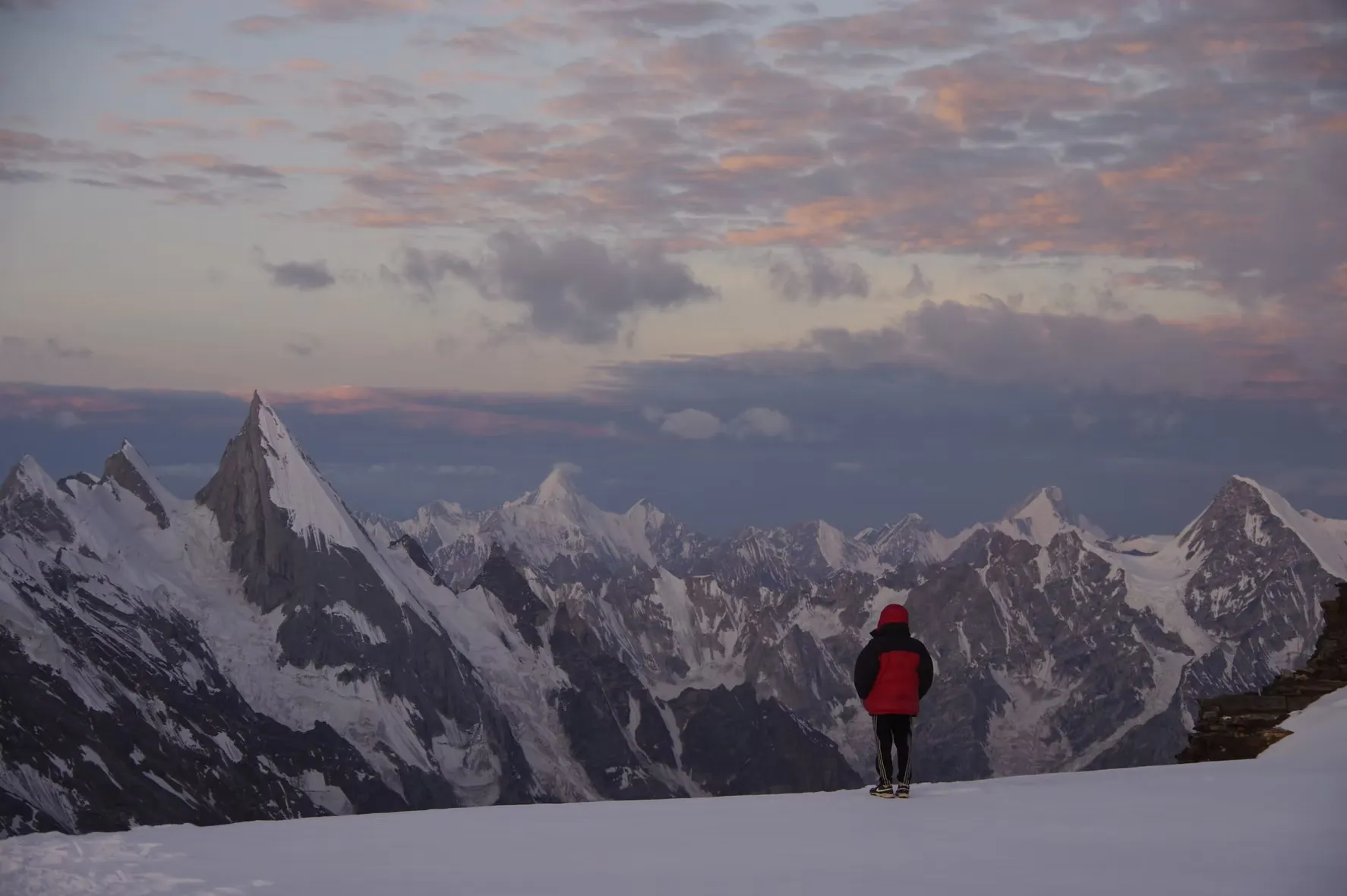
People always ask why we have to start at midnight. It’s not just for the sunrise (though standing at the top with K2, Broad Peak, and the Gasherbrums glowing in the first light is something you’ll never forget).
The real reason is the descent. The Hushe side of the pass is a graveyard of loose rock. When the sun hits that face, the ice melts, and the stones start to fly. We want our teams off that steep, technical descent and onto the safer glacier below before the mountain “wakes up.” It’s a race against the sun, and it’s one of the reasons we emphasize stamina and fatigue resistance in our training plans.
The Honest Verdict
So, is it dangerous?
The Karakoram is a raw, high-altitude environment. There is always objective risk. But is it reckless? No — not if you do it right.
If you try to “wing it” with a cheap crew, skip the training, or ignore the local experts, then yes, it’s a dangerous place to be. But if you respect the technicality, use the right gear, and move with a team that listens to the local Rescue Team, the Gondogoro La is a challenging, breathtaking, and ultimately safe way to see the “Throne Room of the Mountain Gods.”
It’s the bridge between being a trekker and becoming a mountaineer. And for those who make it to the top, the view back toward K2 makes every burning lung and frozen toe worth it.
Ready to see it for yourself? Check out the details for our K2 Base Camp & Gondogoro La Trek and let’s get you ready for the crossing.