
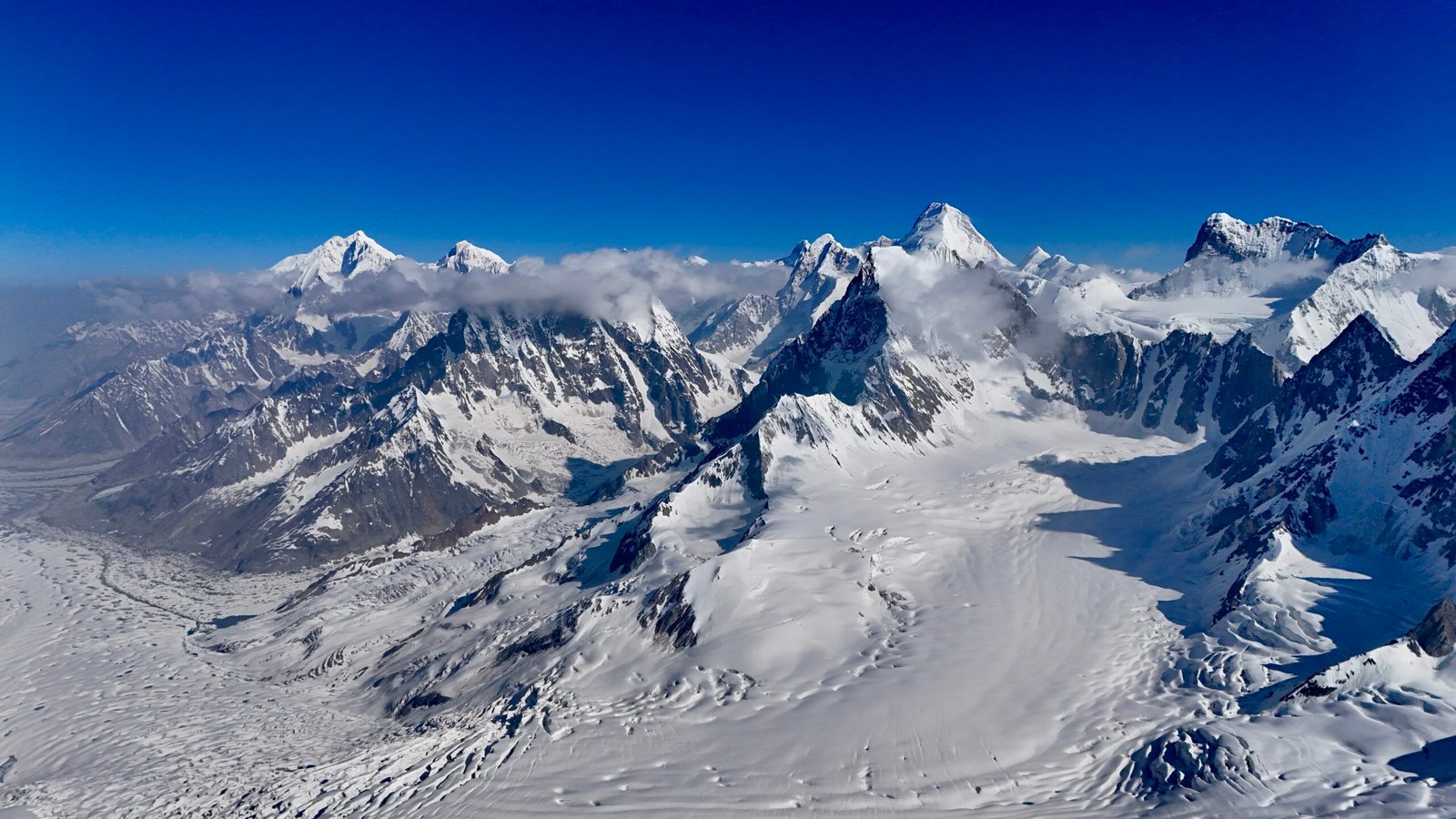
If you’ve already trekked in the Himalayas and are looking for your next great challenge, the Karakoram of Pakistan is the undisputed heavyweight champion of the mountain world. But once you’ve decided to head to the Gilgit-Baltistan region, you’re faced with a difficult choice: Do you head for the legendary “Throne Room of the Mountain Gods” at K2 Base Camp, or do you venture into the ethereal, high-altitude wilderness of Snow Lake (Lukpe Lawo)?
At Moving Mountains, we live and breathe these trails. We’ve spent decades guiding adventurers through the granite cathedrals of the Baltoro and across the vast ice-highways of the Biafo-Hispar. Both treks are world-class, but they offer fundamentally different experiences.
This is our no-nonsense, expert comparison to help you decide which iconic Karakoram trek is right for your next expedition.
1. The Scenery: Granite Giants vs. The Ice Wilderness
The most immediate difference between these two treks is the visual landscape.
K2 Base Camp: The Cathedral of Rock Giants
The trek to K2 Base Camp is all about verticality and scale. As you move up the Baltoro Glacier, you are surrounded by the most dramatic mountain architecture on Earth. From the needle-sharp granite spires of the Trango Towers to the massive, fortress-like walls of Broad Peak and the Gasherbrums, the scenery is dominated by rock and height. Standing at Concordia, you are in the center of the greatest concentration of 8,000-meter peaks on the planet.
Snow Lake: The Ethereal Void
The Snow Lake and Hispar La trek offers a landscape that feels almost otherworldly. Snow Lake (Lukpe Lawo) is a massive high-altitude basin where the Biafo and Hispar glaciers meet, creating a vast, flat expanse of snow and ice surrounded by jagged, unclimbed peaks. While K2 is about the height of the mountains, Snow Lake is about the immense, silent power of the glaciers themselves. It feels less like a mountain range and more like a journey across a polar ice cap.
2. Difficulty and Technicality: Rock vs. Ice
Both treks are demanding and require a high level of physical training, but the technical challenges differ.
The Baltoro Rubble of K2 Base Camp
The K2 Base Camp trek is primarily a journey over rock-covered glacial moraine. It is physically taxing on the ankles and knees, requiring constant focus on your footwork. If you choose the Gondogoro La crossing, you will face a technical high-altitude pass (5,585m) that requires basic crampon and fixed-rope skills. However, for most of the trek, you are walking on solid (if uneven) ground.
The Glacial Crossing of Snow Lake Hispar La
The Snow Lake trek involves significant time spent walking directly on “white ice” and snow-covered glaciers. Crevasse awareness is critical, and teams are often roped together for safety during the crossing of the Hispar La (5,150m). While the pass is lower than the Gondogoro La, the sustained time spent on the glacier and the potential for deep snow make it a different kind of physical and mental challenge.
3. Remoteness and The “Crowd” Factor
In the world of high-altitude trekking, “crowded” is a relative term, but the difference between these two routes is stark.
•K2 Base Camp: As the most famous trek in Pakistan, the Baltoro Glacier can feel like a “trekking highway” during the peak months of July and August. You will encounter other groups, shared campsites, and a sense of camaraderie with fellow adventurers from around the world.
•Snow Lake: This is one of the most remote treks in the world. You can go days without seeing another soul outside of your own team. There are no permanent facilities, and the sense of isolation is profound. If you are looking for a true wilderness experience where you are a pioneer rather than a tourist, Snow Lake is the winner.
4. Logistics and Access
Both treks typically fit into a 19 to 21-day itinerary, but the flow of the journey is different.
•K2 Base Camp: Usually starts and ends in Skardu/Hushe, with a jeep ride to Askole. The infrastructure for the Baltoro is well-established, with reliable porter networks and fixed campsites.
•Snow Lake: This is a “traverse” trek, typically starting in the Askole region and ending in the Hunza Valley (or vice-versa). The logistics are more complex, as you are crossing from one major valley system to another over a high-altitude pass.
Comparison Table: At a Glance
| Feature | K2 Base Camp & Gondogoro La | Snow Lake & Hispar La |
| Primary Appeal | Iconic 8,000m peaks & K2 | Remote glacial wilderness |
| Terrain | Rock-covered glacier (Moraine) | Snow and “White Ice” glacier |
| Highest Point | Gondogoro La (5,585m) | Hispar La (5,150m) |
| Remoteness | Moderate (Popular route) | Extreme (Very isolated) |
| Technicality | High (Pass crossing) | Moderate (Crevasse awareness) |
| Itinerary Length | 19 Days | 19 Days |
The Verdict: Which One Should You Choose?
•Choose K2 Base Camp if: You want to see the world’s most famous mountains, you enjoy the social aspect of trekking, and you want to stand at the base of the “Savage Mountain” itself. It is a “bucket list” trek for a reason.
•Choose Snow Lake if: You have already done K2 or EBC and are looking for something more remote. If you crave silence, vast glacial landscapes, and the feeling of being at the very edge of the map, Snow Lake is an experience that will stay with you forever.
No matter which path you choose, the Karakoram will change you. At Moving Mountains, our local Hunza based team is here to ensure you have the expert support, safety protocols, and local knowledge needed to succeed.